

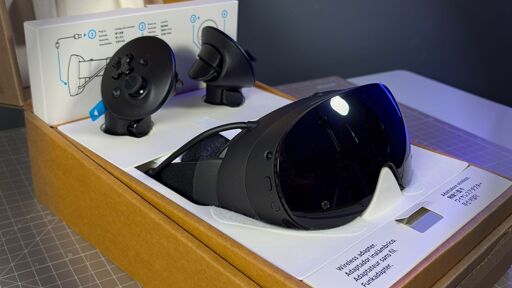
t’s certainly been a journey for Valve. A week prior to the Steam Frame’s launch, we spoke with two engineers at Valve about the project: Joy Lyons, hardware engineer, and Jeremy Selan, software engineer. The memory crisis and the price were a big part of that conversation. From that chat, we can confirm that Valve had aimed for a lower price point than the one it’s launching the Frame for today.
Here’s Lyons on the memory crisis:
“We set out to design this hardware with one particular price in mind, but we’ve made choices to make sure that we’re making a product that is choiceful, that people can purchase, they can upgrade with different features later. But we wanted to make sure we had a base product with really great performance. Then that price target shifted due to the ongoing RAM crisis around the world.”
Lyons also said that forecasting for the cost of certain components used in the Steam Frame is an ongoing challenge.
Not exactly boding well of the Steam Deck 2.
I’m ok with it Valve. I might not be able to pick one up right now but it doesn’t mean I’m not interested. Just please don’t give up on FEX-EMU. That to me is the true value proposition of all this.
That and i really hope it is as open and upgradeable as the steam deck. Valve bought a lot of my good will with the choices for the deck, i hope they don’t meta everything up
Yeah, my experience with the Steam Deck is why I am even considering this despite the price.
ARM is arguably more closed source than x86. Most ARM computers violate the Linux GPL license and run a closed-source fork of Linux.
FEX is cool, but I’ll wait until RISC-V becomes viable before I switch away from x86.
I’m more excited about the waydroid integration, I want to run android TV apps on my Steam Machine.
I’d say ARM makes sense for headsets for now because of the Oculus headsets, but I wouldnt be surprised if the Steam Frame 2 ran on x86.
Chance is higher that Steam DECK 2 will be ARM/Snapdragon. So far nobody seems to capitalize on the fact that x64 ran out of patent protection this year.
Maybe we’ll finally see some more competitors appear in that space and drive competition
The rumors seem to say it will be another AMD chip.
At the moment, there is no ARM SoC that is as efficient at idle as Intel’s Panther Lake, so I dont know why Valve would tie themselves down with Qualcomm and have bad Linux support and shitty BIOS.
It’s hard to look at the new Intel Panther Lake processors and see that the advantages of ARM outweigh the disadvantages. Look at the new Intel handhelds, they just operate on a whole new level of efficiency.
I have yet to be aware of any Intel Arc G3 handheld that manages to come down to the 540g in weight of a Switch 2 console. The Acer Atlas 7 has a smaller screen and yet weighs a bit under 700g, so 150g more while it has a smaller screen.
No but they’re also far more powerful than a Switch.
That’s just wholly incorrect.
Can you run Linux on your cellphone, can you run Linux on the Raspberry Pi 5? No, you have to use the manufacturer’s closed source OS (forked from Linux). Some manufacturers release their source code, but a lot of them don’t.
Here’s a blog explaining how you can’t run vanilla Linux on a raspberry pi and the extremely complicated way to use the open source raspi code to compile your own kernel:
https://blog.bktus.com/en/archives/czh2is/
Yes, I can. Manufacturers literally CAN NOT closed-source fork the kernel, because of its licensing. They HAVE to release the exact kernel sources used for the device.
You can also run fully open Linux on your Pi5. There will be some firmware blobs, but then again so will any x86 board.
Oh, and smartphones run ANDROID. Not just Linux, but a completely separate layer on top of it that is much different from the traditional desktop environments. Android isn’t Linux, it runs on top of the Linux kernel. Sure manufacturers don’t release their Android source, because they don’t have to, but equating Android with Linux is idiotic.
You seem to have a very… loose grasp as to what is considered open source and what “Linux” is.
Here’s a quick bootcamp: any fork of the Linux kernel is still Linux. Does the RasPi5 require a custom kernel? Yes. Does that make it any less open? No. Does that make it any less Linux? Also no.
The kernel sources for Raspberry Pi boards are readily available. No request for access needed. You can clone the repo any time. That is open source.
Samsung, Google, Motorola, Xiaomi, OnePlus, Nothing, etc. all either provide open repos for kernel sources, or provide them upon request (as per the GPLv2 license of the kernel). That’s still open source. And just because each phone manufacturer - as well as each SoC manufacturer - had to make changes that aren’t in mainline, doesn’t make that any less open or any less Linux.
In fact Google has been pioneering a way to get better kernel baseline support via GKIs, and manufacturer support for a lot of boards and SoCs have been introduced in the mainline kernel.
But the thing is that ARM is progressing fast, with quite a few SoC/core manufacturers on the market (Qualcomm, Apple, Samsung, HiSilicon/Huawei, MediaTek, Amlogic, Allwinner, Broadcom, Rockchip, NXP, UNISOC, and so on), whereas X86 has two manufacturers who do end to end development in-house, and at a slower pace (usually one class of CPUs announced a year). The thing is, mainline WILL pay behind because ARM just progresses so fast that reviewing all the changes to add a new SoC to the supported list cannot happen overnight. That’s why forks exist.
But, I repeat, that fork makes it no less Linux nor any less open source.
Legally aren’t allowed to, may not care anyway. Chinese legal system doesn’t enforce this.
The big ones obey, because they have international presence. From what I’ve heard, the small ones will provide it on request, since chances are they have no financial reason not to anyway.
Yep.
A decade or so ago it used to be that GPL source requests/demands were an uphill battle. You had to beg, threaten legal action, for months to get somewhere.
Nowadays most manufacturers recognise that open sourcing actually helps them because people will create custom ROMs, or do the kernel upbring for newer versions the ODM refused to, so now with 0 work you have a new BSP and can push updates faster.
Yes and also yes. What???
Your phone runs mainline Linux? You dont need to download a closed source binary blob from the vendor?
Does your phone show up on this list?
https://wiki.postmarketos.org/wiki/Devices
Notice how I dont have to ask this question if somebody owns a normal x86 computer.
Troll harder bud.
Yes, you do have to ask that question, dummy.
Just look at every single newer generation x86 CPU. Until direct support is added in the kernel (which usually happens early on because Intel and AMD use a singular architecture for each generation so support is easy), shit’s so broken it won’t even boot.
Except, you know, the CPU microcode package, the GPU drivers, the WiFi, Bluetooth, etc. firmware (via the linux-firmware package), and the list goes on.
Buddy, we’ve already established that your knowledge of Linux et al is surface level at best, why are you still digging your own grave with verificably incorrect/incomplete statements that literally move the goalposts of this debate every time you reply?
Wtf? The vast majority of phones do run Linux, and most of the rest (iPhones) run UNIX. And since when is raspberry pi 5 not Linux?
I’m taking a very narrow definition of Linux here to say that a manufacturer shipping you a disk image with a precompiled version of Linux (that is closed source) is not proper linux.
If Linus Torvalds and co can’t make your computer run, then its not a good computing experience.
Darwin != Linux, either.
Darwin is UNIX. And anyone who knows what they’re talking about wouldn’t confuse the two.
lol
I can absolutely build the Linux kernel for arm from source for the raspberry pi. Whether it is using the open source raspberry pi fork or mainline. I can put any of at least a dozen fully open distros on it. Etc.
Maybe there’s some devices/manufacturers doing this and that’s what you’re thinking of, but your core argument here is 100% wrong.
some devices = virtually every android phone.
Also, Android is linux, lol. Just because some phone models don’t allow you the freedom to build-from-source doesn’t change any of that.
deleted by creator
Lots of distros “aren’t the same”, but android runs the Linux kernel at its core.
Whether you like it or not, it’s Linux
deleted by creator
Someone is making a real fool of themselves here, amirite?
The ability to run GTK apps maketh not what Linux is…
Yes, I am running PostmarketOS on my cellphone. It is called PinePhone.
Yes and yes. In fact, I currently do both of those.
OK cool, how much is broken when you use a mainline kernel, like the one I use on a normal x86 laptop?
Nothing. Also, why do you keep changin the requirements? First it was “you can’t run Linux”, then it became “you can’t run a mainline kernel”.
Even DietPi where you can install it to pretty much everything? Even x86. Even armv6.
deleted by creator
The drivers are also open source, genius.
Honey, you can even run Asahi Linux (fully FOSS) on Apple Silicon. WTF are you taking about?
Not for a lack of Apple trying to lock it down.
Asahi Linux does not work on the latest macs, and most of the features on M1/M2 do not work.
You dont have these issues with x86, because it is more open source than ARM. AMD and Intel treat Linux as a first-class citizen and upload code for their computers directly to Mainline Linux.
Literally, none of these things is true.
If you spent as much time on research, as you apparently do one making shit up, you would know that.
deleted by creator
First of all, ARM is not owned by Apple, and if it weren’t so open, so open source friendly, Apple would not have been able to create Apple Silicon chips in the first place.
Secondly, lol, Asahi Linux proved that, not only could apple’s apple silicon chips be reversed engineered, but that it was both a worthwhile enterprise and that Apple wouldn’t come after them. Because Apple officially stated that they just do not care. Apple intentionally designed the chips to be capable of booting and running alternate operating systems. They, themselves, created a very clear and open development pathway.
Oh, not to mention that it is definitely Linux.
So… That’s what the fuck I’m talking about. Again, what the fuck are you talking about?
deleted by creator
– person who doesnt know anything at all about the entire marketing behind the steamframe