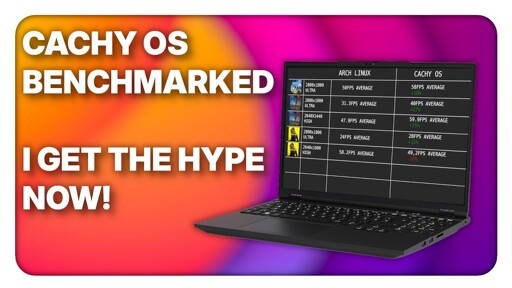

Small sample set aside, the performance differences here are much bigger than I’ve seen in previous linux comparisons. Something has to be off right? Curious if anyone is able to reproduce these results.
30min video, 10mins of promotions… nope

Good thing SponsorBlock will automatically skip the segments for you so you can enjoy the 20 minutes long video!
Bro you literally already have sponsorblock installed, nothing for you to worry about. Let a man earn his living
I hate to keep being in these threads saying the same thing, but new people need to know:
THERE IS NO APPRECIABLE PERFORMANCE DIFFERENCE BETWEEN ANY LINUX DISTRO FOR GAMING
Doesn’t matter if it calls itself a “gaming” distro, or it wins by 10% in some benchmarks here and there. Any distro can be tuned like any other distro in every single way. No distro has any proprietary bits that make it better than another, and even if they did, you’d see devblogs or GitHub scripts you can one-shot to tune whatever you’re running to perform similarly.
Save yourself from falling for the hype, and save yourself the time of sitting through videos like this.
Any distro can be tuned
Yeah but people are too lazy to do this lol
Yeah but I’m dumb and I need distro maintainers to tune it for Me
#facts
I would not recommend CachyOS to any beginners because after installation it still behaves like regular Arch. Just from today’s update:
Replace vlc-plugin-kwallet with cachyos-extra-v3/vlc-plugin-libsecret? [Y/n]
That said, I don’t agree with your claims. CachyOS puts a lot of effort into optimizing performance (at the cost of other things, e.g. disk space, server load, support for older hardware, …), especially for gaming workloads. There have been many benchmarks that consistently show it performing better than other distros out-of-the-box. Generally, the advantage seems to be in the 0 to 15% range. Does that matter? That probably depends on who’s asking.
You are correct that all the optimizations are open for everybody to see and copy. However, the mainstream distros don’t seem to be interested in doing that for now. And applying the CachyOS optimizations (different kernel, scheduler, optimized packages for Zen 4, …) to other distros (say Ubuntu) is not really feasible or advisable for most users.
PS: I had to look it up, and of course people tried xD.
I’m a Linux casual. Could you go into some more detail on what you’re communicating with that update quote? Why is that bad?
It’s not bad. It’s just assumes you know what you’re doing. That y/n option there, is one of them. I’m not a power user or anything, I know my way around a computer.
I’ve been using CachyOS Linux since last October as my one and only OS on my laptop. It going great. There are some annoying stuff as well but that’s because of Linux in general and not CachyOS specific. Laptops have many Linux unfriendly hardware in them so, you don’t get full support out of the box if yours is brand new, however if you have a 1 or 2 year old laptop than it will most likely work out of the box. As for other examples of annoying stuff, I had problem with making my gaming mouse work and map the buttons, I went and asked AI to how to fix it and I’ve got it done. Because I couldn’t find anything specific in the forums. Or just the other day I was having problems with my gamepad button mapping and had to ask AI again to fix it and it did.
As for what I’m doing when I’m asked a y/n question like the example given I do a quick search and 9/10 times the first link would be the answer I’m looking for and I choose accordingly. Or you can go the ignorant way and just chose yes to everything (which I did before) and you’ll be alright 99.9% of the time. I don’t remember having problems because of it…
So, it’s not that mysterious or hard to understand and as a side effect you learn new stuff. Which is fun for me.
Yeah, ‘y’ every time should be pretty safe for updates, right? Like, the reason it’s suggested is because it’s the suggested alternative for the package it’s replacing and the change has been tested by the CachyOS/Arch team(s) already.
And worst case, something big breaks when you reboot, so you roll back to before the update, wait like a week, and try again (lol).
It’s a type of question that Arch/Cachy often ask during regular updates. Here it’s about replacing a package. Sometimes you also need to make a choice between multiple packages or even perform some manual actions (see https://archlinux.org/). This requires you to possibly look it up, understand the change, and make a decision. If you screw it up, you can break your system.
My point was not that this is bad. Arch Linux is intentionally and explicitly targeted at proficient users. This is part of the deal. It can even be nice, because it gives you more insight into and control over what goes on under the hood in your system. However, I don’t think this is a good experience for (most) new users.
Man, you got me SWEATING. “Did I miss an archannounce regarding VLC? Why tf would there be an arch-announce for VLC?!?!”
Due to the VLC updates taking up too many lines in our terminal, we have decided to drop VLC from the extra repository. Users who wish to play back videos can install them from the AUR.
jk
You can tune any distro to any degree you want and replace everything including a custom built kernel to get performance. But you know not everyone can/wants to do that, I have a toddler so I’m not going to take a whatever Debian and install a new scheduler and whatever just cause.
You might forget that Linux desktop is growing super fast and fiddling with stuff under the hood is not that common and noobs and people with experience end up fucking things up constantly. Having something that’s performant, optimised for your use case, whatever optimisations baked in won’t break with updates and you can just install it and forget is a really big deal. This is just not something that was available.
I think you should stop the hate and allow people to be happy with the distro they like for whatever reason.
Lolol.
Your last line. Saying exactly what I’m saying, dawg.
No it’s not. Not even remotely. Words have meanings. Your and his are not the same.
He’s right and your wrong on this one chief.
Removed by mod
Small sample set aside, the performance differences here are much bigger than I’ve seen in previous linux comparisons. Something has to be off right? Curious if anyone is able to reproduce these results.
Unfortunately the reviewer doesn’t seem to mention a bunch of details about how the games were actually played such as, critically, which version of Proton he used. CachyOS ships its own version of Proton which pulls in a bunch of bleeding-edge features with significant performance impacts. I’m not sure if that Proton is used by default or not though; it may depend on the specific launcher used and configuration. Without knowing that, it’s going to be difficult to attempt to reproduce his results.
Yeah, I like Nick but benchmarking isn’t his forte. In all the articles and videos I’ve come across, most distros perform similarly, usually within the margin of error for most games. I can’t imagine any set of optimizations that would lead to a performance increase on the level of a gpu upgrade. It doesn’t make sense.
Wendell talks about cachy quite a bit, I wish he’d do some testing but I’m sure he’s already busy enough.
Yeahs it’s very very rare that cachy performs THAT much better. Its normal for it to be 1-3% faster then other distros since it’s pretuned and all.
But beyond that… Iv only seen it have larger jumps like once or twice.
It’s running through Proton, he mentioned that in the benchmarks it shows up “as playing on windows” because of Proton.
Other than that Nick is pretty transparent about what he does, if something is not mentioned it’s likely whatever is default on the distro when running steam through flatpak (flatpak was mentioned).
I’m still trying to get secure boot working… Their secure boot script might be missing some files to sign :(
Just disable it, the “secure” in secure boot is a security for whoever needs to ship signed crap in windows or if your employer needs to spy on you. On a linux gaming laptop its perfectly useless.
The main reason to use cachy is not the performance. Its the lack of the absolute cancer that is a normal arch install. But cool that it actually does come with gaming configs that make a difference.
archinstallstraight from the ISO is cancer?Yes, a non graphical installer is inacceptable if you are trying to get normie people to switch to it from windows.
I for one, would not suggest a Windows user to go straight to Arch. An Arch derivative, maybe.
That’s why they said they would recommend CachyOS. ;)
I did however go from Windows to Arch. It wasn’t a bad experience, and using command line isn’t a big deal (to me at least.) But I am not the average Windows user. (Background in IT, for over a decade now. And I enjoy this stuff.)
So mileage may vary.
CachyOS is nice, I have used it; and I quite like it. I still use vanilla Arch for my machines outside of my steam deck.
I personally know 3 people that have switched from lifelong windows to Cachy as their first linux experience and have had minimal issues. None beyond anything you would have on other distros. Im not using it myself, but i know it does what its supposed to, it just works…
I swapped off Windows to Mint at the start of the year but I’m looking for my next distro for my next system. So far I’m pretty set on CachyOS. Fingers crossed I get a similar experience.
Edit: Added some context to my normie recommend statement, as I was in a rush…my bad, as I wasn’t calling out the person I was replying to…Just saying in general.
The TUI is still a lot better than having to type in terminal commands in the correct order…The downside is needing an internet connection to get archinstall going in my opinion. CachyOS’s installer has a tendency to fail as well. Which is something that isn’t often talked about. I had so many weird experiences with it, like it failed to install the kernel, boot loader, etc. Garuda Linux is probably the best for those with a desire to tinker to be perfectly honest. A good starting base that doesn’t fail at all.
Recommending any Arch based distro to a normie is basically a nonstarter and kinda unhinged behavior to be totally frank. I’ve honestly seen this and my gasters were flabbered. I always made sure to always redirect the person getting the recommendation to a saner one. As keeping people learning Linux is a good idea, making them leave because of frustration is…Not good.
It would be better to direct them to Mint, Fedora, or even Bazzite (depending on their needs). As the graphical installers are pretty good there!
Typing terminal commands is actually the easiest and the fastest way to install a Linux system. It’s just not a normie way, obviously. For the folks that know what they’re doing and why they’re doing it, it’s just really simpler than walking through a GUI.
Most folks that know what they are doing would probably just reproduce their existing install (with some tweaks to account for hardware) with a config file and skip the fuss of typing too much, just the essential stuff. For me at the moment, I find graphical installers to be breezy as fuck, yet, I could see a time when maybe vanilla Arch is in my grasp. LOL Perhaps.
Right you are! I needed to install Linux like five times recently, this month alone, and the best I invented is to just clone my laptop’s system (Arch, by the way) and then tweak a few things here and there. In the future, I guess I won’t even bother installing when I can clone my system within minutes (and half an hour on waiting for rsync to finish).
Yeah doubt Arch will be making any 4K 3D rendered graphical installers anytime soon. Sorry normies.
Well thats why Cachy exists, for sane people :)
I got curious which installer CachyOS uses, and it looks like they just use their own fork of Calamares. To be fair, there is a Calamares installer for Arch as well, its just not included in the ISO. If it got enough popularity votes from the AUR, they would probably consider including it in the ISO, but there doesn’t seem to be any demand for it.
Arch isn’t meant for normies though, so they don’t have to cater to them.
Makes me wonder how it compares to Garuda, which is more gaming-tailored and has a graphical installer.
Garuda suffers from having absolutely dog shit defaults and tools compared to cachy for new Linux users.
Not even talking visuals.
Cachys custom scripts, tools and helpers make Garuda look like a fucking joke from a professionalism standpoint. And makes cachy infinity easier to get going and use day to day for a new Linux user.
Cachyos is about as new user friendly as you can physically get on arch short of SteamOS.
If your an advanced user then both Garuda and cachy might as well be carbon copies. Its just a starting point for us. Everything’s getting fiddled with anyways
Garuda defaults feel like you’re fixing someone else’s computer and you have to remove all the toolbars
How about endeavour. That has a graphical interface for an arch install. Been using it for a few years already after windows 10.
Normies aren’t meant to be using Arch. Go get that popular piece of shite distro instead. Or better get Fedora or popos. Or Mint. Or whatever the next guy recommends. Like, FreeBSD, or better OpenBSD.
ROFL FreeBSD is also kinda normie hostile, as the TUI installer will get you mostly there, but after that there is additional terminal based config that needs to be done. Also, a user just gets dumped in a TTYL window with no WM or DE (that must be installed by the user). For me, it’s a bit better than just straight up Arch because the FreeBSD installer gets you so very close to the finish line. It takes the user (reading the handbook carefully) to get the WM and DE installed and configured correctly for their needs. I could see myself unironically installing that successfully over vanilla Arch which is fucking weird but true.
Well, the FreeBSD and OpenBSD was more of a joke :) but, a normie just expects things to be very Windowsish, and when it’s not and even simpler, they’re getting lost for no real reason. It’s just different to what they’re used to. However, I’ve seen people not familiar with Windows well enough handling Unix-y interfaces okayish.
To me, installing Arch is just very easy, as I’ve done it many times, and use the system for close to decade soon. It’s formatting your disks, adding that to a config —
/etc/fstab— which is done with a simple command. Then you mount that disk of yours,pacstrapthere (which means installing basic packages), chroot there, and do some more settings like setting locale and a hostname (and I guess missing to do it won’t brick anything, so you can skip or forget), perhaps something else you need to setup anyway, like creating a user. Install a bootloader, reboot. Done.FreeBSD is simple, but to me it’s not that simple, as its installation process is next next next, I don’t even remember how I installed it. Under the hood, I guess that’s all the same.
By the way, I thought it’s worth mentioning it’s obvious that next next next approach is simpler to anyone. It’s that Arch’s way is simpler to someone who needs more control for some reason, or install these things often enough to justify that approach. It’s wrong that Arch has this vibe of ‘too difficult to even install.’ It’s not that difficult. What is is to know what you need to install and why. That takes years of using that system, so at first you follow some guide not really understanding what you’re doing.
It’s just a matter of learning Linux before dealing with the Arch way of doing things, at the end of the day. As there are guides and shit, but it’s a task that someone should only undertake if they feel ready…Prepared with snacks, the Arch Wiki, and good curse words in case of failure. Personally as a graphical install king, I think vanilla Arch is just TOO barebones, but archinstall is just right. Shame it needs internet to install. However, there is nothing inherently wrong with the Arch way, as long as it is recommended to the right people, there is simply no issues with it. As it is for people that are ready for the next step, a fully minimal system that is set-up in the way they like. However, perhaps Gentoo would be better for maximal precision, as there are a lot of ways to shape the system and the applications you install to suit user purposes on Gentoo. Not that I would know how at the moment, perhaps when I have plenty of time to learn.
I honestly wanted to point out the whole FreeBSD thing in case someone took it at face value. As yah know, sometimes sarcasm doesn’t translate well for people (note that I laughed with a ROFL myself thinking your being silly not serious).
I think FreeBSD is actually great, I’m looking for a reason to install it on anything just to have it around.
And Gentoo too. I’m currently on a MacBook Pro (2014, Intel era) with Arch Linux. Weirdly, the hardware support is great, and it feels like even better than macOS. For some reason, some other MacBooks I have are much worse with some things Linux. Eg sleep and battery life estimation. But apart from that, they’re better than macOS, as they’re long obsolete.
I want to have Gentoo somewhere, and I’m just not sure where to start. It surely have to be a separate machine to not hurry with the install and setting it up. (However, I expect that most if not all my user configs would just work, assuming the same software stack.) But that machine is expected to be powerful too!
At this point, I think of getting a MacBook Air M1, perhaps the next year. Or maybe even years, depending on real life events, that’s rather a cool toy to me at this point than a real need. But ideally, I’d like to have it when being obsolete (not supported with macOS updates) and Neo having at least two or better three generations. Which would make its price to value very attractive. I thought of having Gentoo there, since Arch is not supported, and I’m not a big fan of Arch Arm project.
I would like to use Gentoo so much, I thought of actually getting a used somewhat broken MacBook Air (I’ve seen one with partially broken screen for like a bit over €100), and use it as a test machine. Then, just buy another one, in a better shape when it would enter its obsolete state, which would inevitably happen at some sooner rather than later point.
I expect it would be just perfect for Gentoo. FreeBSD, I have no idea. Thought of getting a tiny PC just for it, without any purpose in mind. Perhaps I’d find one along the way. I’ve researched briefly, and there are either Mac minis of 2014 with a very nice idle energy consumption and price locally (about €100 or even less). Or some N100 Chinese similar computer, but I have no idea about the hardware support.
Skill issues