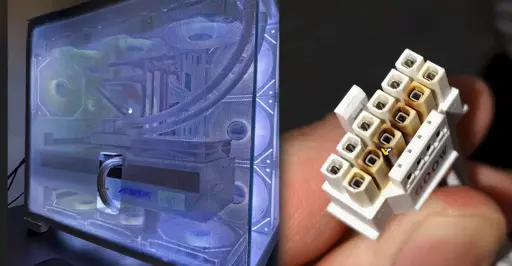
A Gigabyte RTX 5090 user modified the case around the 16-pin cable and still experienced connector damage. Repairing the GPU-side header cost around $90.
It’s hilariously sad how bad the 12vhp standard, the implementation is.
Nvidia did make a shit power connector standard, though.
Honestly, the entire concept is pretty dumb – 6 different connectors to deliver the same +12V DC power. Trying to split it between different connectors is stupid. It’s the same source, same destination, but when splitting the power without some fairly complicated power electronics to balance the load, you’re just asking for trouble. Electricity will follow the path of least resistance. If one of the connectors has a slightly better connection than the others, more power will flow through that one, and less through the others. While the connectors can handle the load when it’s perfectly balanced, they can’t handle the load when too much of the power is flowing through one of the connectors and less of it through the others. The one that’s conducting the most power will overheat.
The main power connections should instead be large single conductors and large single connectors. One big +12V connector and one big ground connector, along with thick single wires connecting each to the power supply. Make them as big as necessary to supply the 600W or more that the biggest modern GPUs want. Will that make it a bit more expensive? Yes. But only a bit – it would be a tiny fraction of the cost of one of these GPUs, and well worth it to protect the investment that the GPU represents.
(Hell, go ahead and future-proof it by making it capable of ~1800W, so even if you have an independent power supply just for the GPU, and it’s maxing out a standard household outlet, it will still be able to handle that absurd power demand. At anything higher than 1800W, the house’s wiring will be the limiting factor, not the GPU’s power connector.)
This ‘share the load among multiple connectors/conductors’ strategy is only here because the standards we have now are built upon a hodgepodge of previous standards, trying to power these extremely power-hungry GPUs with power infrastructure that’s based on trying to be compatible with old Molex shit that was never meant to handle this much power. Make a new standard from the ground up. Stop this insanity of trying to split the load between multiple conductors without load balancing.
It would make more sense to run a rail through the motherboard, plastic a short slot inline with the pcie slot toward the rear by the ports and power that way. The separate cable thing always felt hacky to me.
A good power supply will have good OVP and OCP protections to help keep the various connections from frying the power supply and hopefully save the equipment unlike a cheap one but at the end of the day cheap or expensive, power supplies are not pushing current over to the equipment, just responding to the pull from the equipment.
Unless this cheap power supply was shorted and just flowing current over to the GPU, I doubt the power supply was a major factor in this connector failing considering all of the information we know at this point.


deleted by creator
Even on cheap power supplies we weren’t having this issue with other connectors.
Probably a contributing factor, but probably not the cause
Nvidia did make a shit power connector standard, though.
Honestly, the entire concept is pretty dumb – 6 different connectors to deliver the same +12V DC power. Trying to split it between different connectors is stupid. It’s the same source, same destination, but when splitting the power without some fairly complicated power electronics to balance the load, you’re just asking for trouble. Electricity will follow the path of least resistance. If one of the connectors has a slightly better connection than the others, more power will flow through that one, and less through the others. While the connectors can handle the load when it’s perfectly balanced, they can’t handle the load when too much of the power is flowing through one of the connectors and less of it through the others. The one that’s conducting the most power will overheat.
The main power connections should instead be large single conductors and large single connectors. One big +12V connector and one big ground connector, along with thick single wires connecting each to the power supply. Make them as big as necessary to supply the 600W or more that the biggest modern GPUs want. Will that make it a bit more expensive? Yes. But only a bit – it would be a tiny fraction of the cost of one of these GPUs, and well worth it to protect the investment that the GPU represents.
(Hell, go ahead and future-proof it by making it capable of ~1800W, so even if you have an independent power supply just for the GPU, and it’s maxing out a standard household outlet, it will still be able to handle that absurd power demand. At anything higher than 1800W, the house’s wiring will be the limiting factor, not the GPU’s power connector.)
This ‘share the load among multiple connectors/conductors’ strategy is only here because the standards we have now are built upon a hodgepodge of previous standards, trying to power these extremely power-hungry GPUs with power infrastructure that’s based on trying to be compatible with old Molex shit that was never meant to handle this much power. Make a new standard from the ground up. Stop this insanity of trying to split the load between multiple conductors without load balancing.
It would make more sense to run a rail through the motherboard, plastic a short slot inline with the pcie slot toward the rear by the ports and power that way. The separate cable thing always felt hacky to me.
Youre right. They could also make more efficient GPUs, we dont really need more performance anymore.
We do need more performance for AI though! /s
May it die a horrible death where all investors go completely broke.
A good power supply will have good OVP and OCP protections to help keep the various connections from frying the power supply and hopefully save the equipment unlike a cheap one but at the end of the day cheap or expensive, power supplies are not pushing current over to the equipment, just responding to the pull from the equipment.
Unless this cheap power supply was shorted and just flowing current over to the GPU, I doubt the power supply was a major factor in this connector failing considering all of the information we know at this point.
Power supplies don’t set cables on fire from the end opposite the psu.