

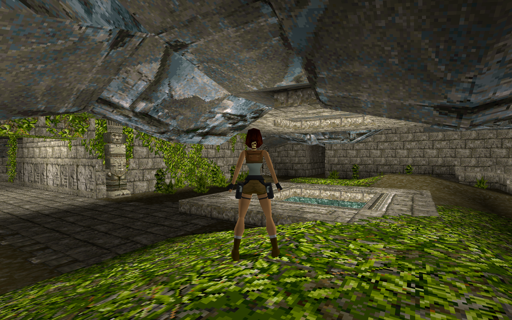
The esp-32s are a thing of wonder. Love them for building random shit.
The port is here: https://github.com/alexkid77/openlara_esp32p4
and the author’s name is Alejandro Villegas Alonso.But because he posted a video of his project on YouTube, PCGamer reduces him to the name of the platform he posted on: “YouTuber.”
The author of this article will henceforth be referred to as “PCGamerer.”
hardware creator Alejandro Villegas Alonso shared a clip of classic Tomb Raider running from a low-power chip
He’s fully credited in the article text. Perfectly normal to not give a full name in a title unless they’re a well known public figure (and even then it’s often shortened to one name if possible).
Yeah but YouTuber is a weird way to describe someone just because that’s where you saw their project. His account has 200 subscribers. He could equally be referred to as a GitHubber or Linkediner.
Personally i would have just said “engineer” or “programmer.”
That’s what passiv voice is for:
Classic Tomb Raider [is made to] run[s] on a chip that sips a mere 1 W of power
Solar panel ambulance gamers in their down time.
deleted by creator
You double posted
Thanks. I got 503 error the first time, and when I checked there was only one comment
A what now?
Lol I’ve got a esp32-p4 and I struggled to get the included example working. So. We’re basically the same.
It’s a very impressive chip but Tomb Raider, wow that’s fantastic
The ESP-32 is actually more powerful than the original console the game was released on.
I wonder about the graphics arrangement? An ESP32 doesn’t usually have video out.
This is built on a P4 dev board with the screen attached, likely over QSPI or RGB888. either a buncha wires or a more buncha wires.
You can drive screen output via the gpio pins quite easily. You can even do VGA output via I²S!
I did not know I2S could do that. I thought it was digital audio.
VGA is basically just a bunch of analog audio signals that, when timed correctly, happens to describe a field of pixels.
Microcontrollers have gotten sooo powerful. I started out using 16 MHz arduinos but today my favorite one (Teensy 4.0/4.1) runs at 600 MHz and can be over clocked to 1 GHz.
Just last week I got a teensy 4.1 and I’m impressed, it even includes 3 channels for CAN communication so I’ve been using for some work projects
Wow, 3? I thought there was just 1. Nice.
Old rombus boobs is back in 2026
There’s a new remake coming out soon too, though she no longer has the rombus boobs. There’s a lot more polygons.
Women cosplaying Lara Croft by stuffing a box up her shirt will never stop being funny.
no body shaming
a 32 bit dual core cpu is probably way more powerful than the low-mhz scale one it originally ran on?
Tomb raider 1996 was a primary title for the Sega Saturn which used hitachi superH 32bit RISC processors at 28mhz and 2m RAM. A little more digging lists the minimum PC requirements for the DOS/win9x version to be a Pentium 60 and 8m RAM.
Not even counting that overall instructions per clock has increased tremendously since the 90s, yeah, there’s plenty of power in an esp32 at 400mhz lol
The ESP32 seems to even do more MIPS per Mhz that the original Pentium, so it’s even faster than a 400mhz pentium would be. Computationally at least
Edit: apparently the Pentium was actually much faster at 64-bit floating point calculations (ESP32 has to do 2 32-bit operations and combine in software), but I don’t think that’s an issue here
Guess it depends on how tomb raider was written. Even on 32-bit CPUs games like quake were still doing 64-bit math
This reminds me of very early mobile ports of this game for Pocket PC PDAs from 2002.
Allow me to geek out a little: The two least powerful of the officially supported devices - Compaq iPAQ 3630 and Toshiba e310 - feature a 32bit ARM-based RISC CPU clocked at 206 MHz, paired with 32 MB of RAM and a 240 x 320 display. The Toshiba cost $899 when it came out in October of 2002, equivalent to $1661 in today’s money (in other words, way too much for a kid who desperately wanted one back then).
Here’s the interesting part though: This CPU - the Intel StrongARM SA-1110 (yes, Intel used to license ARM CPUs)- has a TDP of less than 400 mW when clocked at 206 MHz. This is without RAM, of course, but still, this was a very power-efficient chip for the time - and it could take up tasks that were usually done by other chips, like acting as a softmodem.