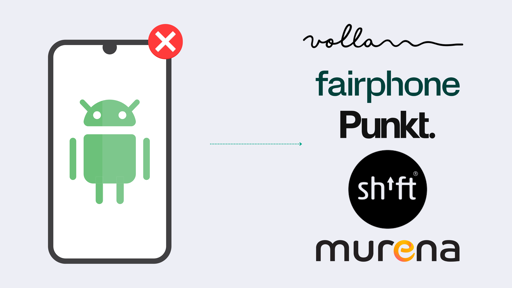
I’ve had my hands on Fairphones and SHIFT phones. Build quality seems similar.
I’d still get a Fairphone, as they put a lot of effort into open source and being part of the community. They also seem to make slightly more robust devices.
No idea for how long Shift guarantee updates, but Fairphone guarantees updates for many years. Last I checked it was eight years.
BTW, I recently got myself a USB-C charger from Fairphone and the build quality is really good. No doubt it will still work in two years and longer. The price is also decent.
Fairphone absolutely is important and may have driven the long update span of phones. But note that because they were the first, they didnt use a secure smartphone SOC in their phone but an IOT one, lacking any secure element for example. Cracking that phone is not hard for people with the knowledge.
Also their firmware and software updates are often far behind upstream, which has obvious security implications.
Citation needed.
Yeah haha I tried finding one but no success.
I know they delayed the Android 14 upgrade and skipped directly to 15, even “bricking” some devices. Probably nothing very bad (though as they allow bootloader locking even on custom Android builds… it could really mean brick).
Of all of those, Punkt is the only one with a headphone jack.
I get it it’s hard to make a good product and sell it cheaply, but at these price points, with the hardware there are providing, installing a custom ROM is the cheapest and arguably the best way to de-google.
Some of these are selling you the 5 years old hardware with today’s flagship killer phone prices. Unless there is a big change in the Android phone market, these prices for these devices will never be justified in my eyes. Not even for the native Linux experience.
We don’t have to settle for just one option. There will always be status-people who buy a brand-new Tesla for 50.000€ because they can afford it. And there are the second hand EV-people, who pay like 10.000€ and still make a difference. Same with de-googled smartphone. Let them buy expensive if they can. I love my de-googled Pixel 4a I bought for like 75€ years ago. Both types are part of the solution.
To be fair buying a /e/OS fairphone also directly helps the development of these alternative systems. Therefore I think its justified to pay a bit more if you’ve got the money to spare.
I agree.~(つˆ0ˆ)つ。☆
In the case of Fairphone you support the further development of /e/OS also financially. Otherwise the alternative Operating Systems will never be able to fully mature.That alone can justify the purchase of a phone in my eyes (if you’ve got the money to spare).
I have nothing against supporting a project nor I can tell you what to do. However Fairphone has been in the market since 2013 iirc. That makes 13 years, yet here we are still getting aged hardware for a new flagship price. Supporting a project such as theirs doesn’t justify the shitty phones they make in my humble opinion.
That’s a fair point but fairphone also tries to manufacture the smartphones more sustainable than the other manufacturers (unfortunately I can’t tell how big that difference really is). Nevertheless you might be right in that it’s maybe more effective to buy another phone and fund f.e. /e/OS directly.
That is a vast oversimplifications. Custom Android builds either rely on reverse engineered drivers, or vendor kernels, or mostly undocumented drivers and custom kernel patches.
Custom “ROMs” are often very insecure, as they use the outdated stock vendor kernel of the original OS, as it is so customized. Not always, but often.
Then you have firmware, which is responsible for a ton of tasks on Android phones, way more importantly than on a PC. There is an entire separate, proprietary chip in there, connecting to sensible and insecure networks like 2G and 3G (the modem/baseband).
And yours is a vast exaggeration. You do realize all of these phones are using either Qualcomm or Mediatek chips and designs which already have those tracking firmwares right?
All of these companies are using these firmwares. As for the Custom ROMs it depends on the device and the custom ROM you’re using. So, calling them entirely working on reverse engineered is a bit much. That’s why these so called free phones need hardware kill switches. Even that article you linked states this. So, unless these guys come up with 100% pure homemade hardware and Linux based OS they will never be free from tracking. Even then they won’t be free from tracking. Hence my point: You can get the same level of de-google and untraceable stuff with using a proper Custom ROM suitable for your device.
This is not about tracking but basic security patches. I feel we are talking past each other
I don’t think we do… I already addressed your firmware point and I believe I said proper Custom ROMs. If you’re calling GrapheneOS, DivestOS, CalyxOS or LineageOS and many more as unsecure and claim they don’t have up to date security patches I don’t know what you’re talking about. Considering that the big Android brands such as Samsung, OnePlus, Xiaomi etc… Lags behind in such security updates as far as one year or never provide such security updates for old devices. You must be ignorant of this fact.
I have an OnePlus 7T Pro which was released in October 2019 and I bought it in 2020 and I still use it with the latest Android and security patches thanks to Custom ROMs. Mean while OnePlus doesn’t provide any updates since January 2023. So, by your claim my phone would be more secure with 2023 security patches than having a proper Custom ROM that has 2026 security patches. Tell me you see what’s wrong with your claim please.
These Custom ROM projects are followed very closely by the community, like Linux project. They provide proper support via Android Open Source unlike your claims to reverse engineered drivers, because the companies are legally forced to provide their source codes. Some companies do it in a timely manner some do it late. From my personal experience phones that have Qualcomm chip sets don’t have problems with having the drivers and source codea. Only the proprietary chipset such as Samsung’s exynos and Mediatek are the problem that needs the revers engineered drivers.
So, to sum up, no, we don’t talk past each other! It’s clear you don’t know what you’re talking about when it comes to Custom ROMs, Android Open Source, how the software and firmware works on Android.
DivestOS is dead. CalyxOS is paused. I specifically meant Android builds that have up-to-date build systems but support devices that are EOL from their creators.
They cannot sign firmware and thus not install it even if it was reverse engineered. And they might not patch an updated kernel to work, and ship an outdated kernel instead.
Thanks for this! I won’t change my Phone (Samsung S21 FE) for as long as it’s working but was looking at Fairphone and Volla/Jolla as Candidates. Good to have a comparsion.
Canada! Canada! Canada! Canada!
We’re waiting over here homies. Give us something. Give us anything.
I use /e/OS on my Fairphone 3+ since more than 3 years and can only recommend it!
And no compatibility issues? I read that some banking apps don’t work well (N26, for example). I’m thinking of buying a ShiftPhone with /e/OS but I’m not sure.
N26 works in my siede and others as well. Always depends on the bank. You can find a curated list here: https://community.e.foundation/t/list-banking-apps-on-e-os/33091
Nice! Thanks for the link :)
Can you install apps from the Google store? Are there apps that refuse to work on it?
You can install PlayStore apps from the App Lounge which connects anonymously. Most apps simply work, always depends on what you use. Apps such as Plexus or Sapio can be used to see if apps work
Why no mention of https://iode.tech/ ? They offer new and refurbished phones with deGoogled OS, including Fariphone and SHIFT. They have a very nice anti tracking software integrated into the OS that doesn’t require VPN running which is a big plus. I’ve been using it for couple of years before I switched to Graphene OS and definitely will consider switching back when my phone dies. Regular updates, couple of nice feature Graphene OS doesn’t have (pattern unlock, configurable shortcuts, system backups). I’m pretty much sticking with Graphene because when I got my phone iode wasn’t supporting it yet and now I’m to lazy to switch back.
What about SailfishOS?
I use it and it’s really nice.
That’s just some Linux userspace with an Android container and an Android kernel. It is mostly still Android kernel and drivers.
I don’t expect them to support devices for very long.
Hmm… are you sure?
In their docs they say it uses the Linux Kernel and bridges other Linux libraries including those used in Android.
It does provide a way to install Android apps in a sandbox.
They have their own hardware phones and do support some Sony Xperia phones, which is the one I have.
It uses the kernel from the SoC vendor, for example Qualcomm, for the Xperia 10 III.
This requires libhybris to get the drivers working with a non-Android userland.
This in turn means the phone can only be updated as long as Qualcomm continues patching the kernel.
And this is why you run an outdated kernel once Qualcomm drops support, which will happen quickly. It’s the same for other SoC vendors. They are in the business of selling SoCs, not supporting them.
Mainline support solves that. SailfishOS can also be built with a mainline kernel.
I am in fact working on mainlining the Xperia 10 III. Once I’m done, you can flash an image with a mainline kernel and continue updating the kernel until the phone breaks, not until Qualcomm stops caring.
Very interesting. Yes I run Sailfish on a Xperia 10 III.
But was not aware of the kernel being supported by the SoC.
Seems like you’re involved in an interesting project.
I’m quite curious about it.
Still early days, but hopefully I’ll at some point have it all working.
This is my current progress: https://git.erebion.eu/forgejo/erebion/pdx213-temp
Next step would be upstreaming some patches to the kernel, I just need to find the time.
Someone more skilled and knowledgeable than me in mainlining could probably get most of the remaining things done in a couple days, but I need to read a lot of docs and try out a lot of things.
That is some impressive stuff, well done!
I’m a software developer but nowhere near kernel stuff.
I do have a curiosity to learn more about kernel development.
Definitely will check it out later.
It’s not that hard, the hardest part is finding the right info, I don’t even know C. I just enable the components that have drivers and leave the rest until someone writes the driver. :)
Can you check how old your kernel is?
uname -rMine is 4.19.248
Very longterm, support ended over 1 year ago. That kernel is 7 years old…
Android is very conservative with kernel upgrades, but this is insane.
Sailfish is based on MeeGo and Moblin and itself has been around for almost 15 years.
Yeah, but that does not change anything about the kernel. You can no longer update it if the vendor drops support. Even if the distro had much older roots, it still uses a vendor kernel that has been patched to death.
Definitely not mostly Android. It’s their own Linux distro/flavour with an “Android compatibility layer” like Waydroid and (gradually open sourced) system components. Ubuntu Touch has a similar approach and I believe postmarketOS as well. I really hope that Jolla’s next community device brings them some more traction and subsequent development velocity. I tried installing SailfishOS on my Fairphone 5 but it is not (yet) a polished setup experience from first boot. If they can polish that, I think it’s a great OS to facilitate a gradual move from privacy-hell. It would allow absolute must-have apps to live in locked down Android compatibility mode while there’s no viable alternative and more and more of your data living in a tracking-free OS.
libhybris literally uses an Android comtainer to bridge over Android kernel drivers from the SoC vendor to the Linux (non-Android) userland.
EDIT: postmarketOS has a mainline strategy, you could create a downstream port, but ultimately their goal is to create strong mainline support for many devices.
AFAIK they offer a way to port their OS to Android devices by re-using the drivers built for Android when building a SailfishOS image for non-native hardware. I personally wouldn’t call that “it’s mostly Android”, but that might be where we have different interpretations. Your initial comment came across as if it was a glorified launcher or a deGoogled Android. If I interpreted that wrongly, my bad. Cheers
I’ve changed wording from “mostly still Android” to “mostly still Android kernel and Android drivers”, I agree, might have been a bit unclear.
Anyway, libhybris requires running half an Android system in a container, so I believe it’d be fair to say it is… half an Android system and a somewhat regular Linux userland with a proprietary UI.
It’s important to know that it can only be updated as long as the SoC vendor provides updated kernel sources.
It’d take months to rebase it onto a new kernel. Just trying to port the drivers would take more time than mainlining. But once you keep things upstream, it suddenly becomes much easier to maintain.
That’s where mainlining comes in.
For example, I am mainlining the Xperia 10 III to make sure it does not become obsolete trash and can still ne used in a couple years:
Nope, in fact, Jolla with SailfishOS is the only one among those mentioned that uses an OS independently developed.
They use an Android kernel. How does it matter how nice their proprietary UI is if the phone can no longer be updated once Qualcomm, for example, no longer patches the kernel?
We desperately need more mainline support, this isn’t sustainable.
It’s time to bring X86 into phones back. Latest X86 CPUs are on par with ARM in terms of efficiency.
x86 phones don’t necessarily have ACPI and x86 alone does not make it simpler.
No, let’s ensure manufacturers upstream early so that we can support devices early.
Now we can’t even ensure manufacturers give us unlockable bootloaders.
We can do hat now, just requires the right regulation…
They use a standard Linux kernel with Android drivers trough libhybris. The proprietary UI and middleware is a mistake, I agree with that
It’s not a standard kernel, it is a vendor kernel. It has sooooo many patches it becomes close to impossible to update then by rebasing. That’s where the mainlining efforts come in: Upstream first.
It’s always easier to maintain something upstream than to try to maintain a downstream fork.
I’d also argue that the mainline kernel tends to have better security, as the drivers have far more eyes on them than the vendor driver kernels.
Writing this on the Volla Quintus. It’s a nice phone. Best features are the springboard and the boot manager.
do you use any banking apps? if yes, are there any difficulties?
I use two banking apps and an NFC payment app and all of them work without any problems. You just enable micro g and when you’re done, you disable it again.
responding on a pixel 3a running android 15 via lineageos
Uhm your phone is EOL since a very long time. I hope you never turn off airplane mode
but I have a community security patch from this year
Cool. Now research what that even means.
(It does not include firmware, baseband firmware i.e. anything running with airplane mode off, likely the kernel)
i think it has an up to date kernel… but yeah i bet it doesnt have updated firmware… is that really that bad?
I used CalyxOS on Fairphone (still waiting for the new one) and that was a good experience. I had completely degoogled main profile and then work profile with microG for things that doesn’t really work without google services or for apps that I simply needed but didn’t want running all the time. And the work profile was off most of the time. It was a good balance for me. Now I am waiting and using LineageOS, but will jump on the CalyxOS bandwagon once they are back. Also prior to CalyxOS I waited for any ROM, I had just pure FairphoneOS (just an android) and honestly, Fairphone should do something about their software because there were a lots of bugs, some were not solved for a long time and when custom ROMs became available, they were better tuned than the FairphoneOS. I mean seriously, good hardware bad software…
CalyxOS is great, I hope it comes back strong. If you want to try another degoogled OS based on Lineage with flexibility to install/uninstall any system app (like microG) and a built-in tracker and ad blocker I’d recommend IodéOS: https://iode.tech/
I was looking at iodé several times in the past and I don’t know why but it doesn’t click with me. Maybe I will check it out again, but I somehow don’t trust it 😀 Maybe its the way they present themselves, if you look at the pages it looks like some company that is just trying to sell me stuff 😀 (well they actually do, one of the first things is “buy an iodé phone”).
Indeed, they sell phones with their OS preinstalled, but they also offer an open source OS for free for anyone to download an install. In the end they need some income, and I’d rather they sell phones (saving the user the trouble of installing another OS on their phones) than do it through ads or other ways that offer no value for a user.
Don’t get me wrong, I totally get it and that is not the issue, I just didn’t feel I should trust them, but as I said, I will look at them again :)
I wish one of them would be supported by grapheneos. Imo the best privacy os but only available on pixel devices
Any idea how hood the cameras are on these? I specifically got myself a (used) xiaomi 13t for the Leica optics, and will probably not change before it dies (because of money) except if I can sell it and switch ofc.
Fairphone camera is usually very good with enough light. Only issue is low light.
Weell that’s where good cameras shine…
Maybe another iteration, or gotta check out the quality a bit closer I guess
You can throw Punkt out of a window.